

Buffalo or Bison: what is in a name?
(adapted from The American Buffalo in Transition, by J. Albert Rorabacher.)
Scientifically: the term “buffalo” is incorrect for the North American species. Its proper Latin name is “Bison bison.” However, common usage has made the term “buffalo” an acceptable synonym for the American bison.
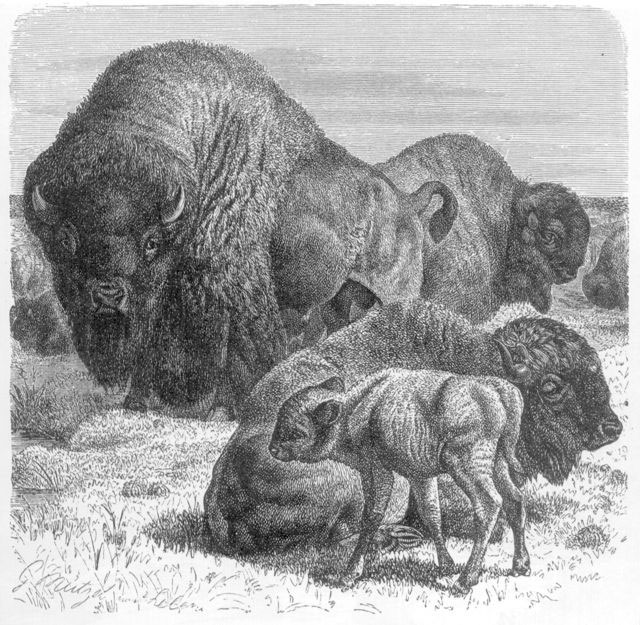
History of the name: In the seventeenth century, French explorers in North America referred to the new species they encountered as “les boeufs,” meaning oxen or beeves. The English, arriving later, eventually modified the pronunciation to “la buff.” The name became more distorted as time passed, becoming “buffle,” “buffler,” “buffillo,” and, eventually, “buffalo.”
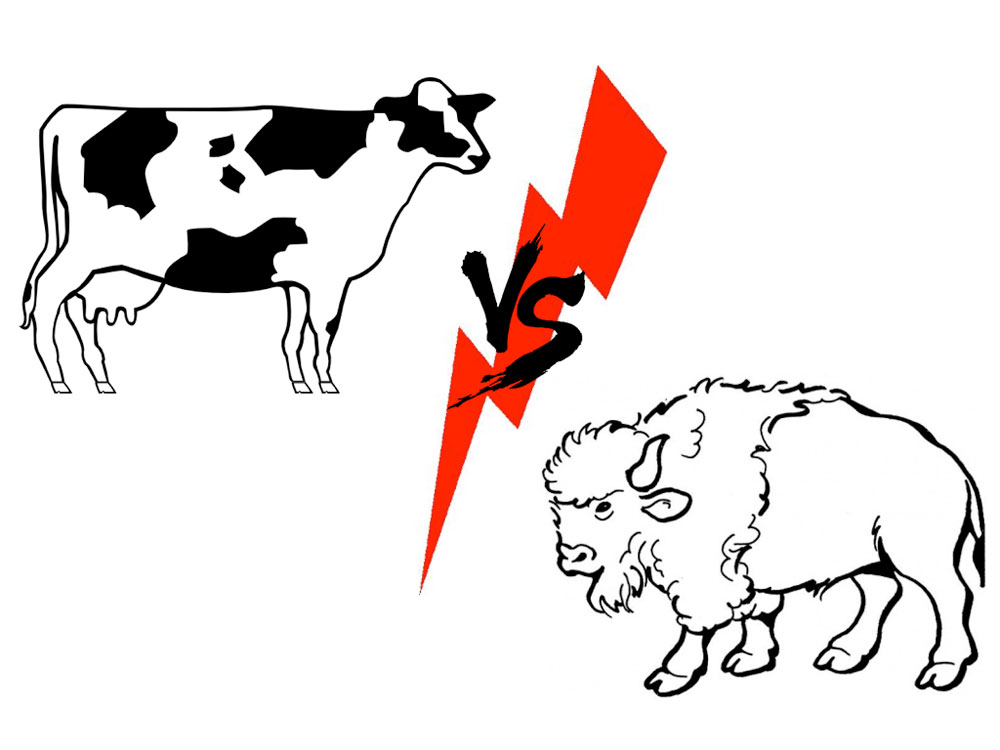
Wild Buffalo vs. Domesticated “Beef-alo”
Buffalo are an important native wildlife species in North America. The migratory species once roamed vast territories covering one-third of the North American continent from the Great Lakes region across the Appalachian Mountains to the Gulf and Atlantic Coastal Plain, the Chihuahuan desert, through the grasslands and prairies of the Great Plains into the Intermountain basins, from the Rocky Mountains to the Boreal Forest, and reaching the Arctic Lowland Taiga. Sadly, buffalo are now mainly found in small, isolated herds that are intensively managed behind fenced or limited ranges.
Nearly all of the buffalo you see today live on ranches and are bred for livestock production. Referred to as “domestic buffalo” or “beefalo,” they are privately owned, managed with animal husbandry techniques, and bred for meat production. Many carry cattle genes, a legacy of historical experiments by ranchers and the government to cross breed cattle and buffalo for commercial purposes when buffalo were nearly extinct.
In public or public trust herds, buffalo are “Near Threatened” with few populations functioning as wild in North America, according to the International Union for Conservation of Nature (IUCN report on the American Bison).
Domestication of public trust buffalo herds is evident in the small herd sizes, isolated populations, limited and fenced ranges, intensive management interventions, and artificial selection processes in the absence of natural predators. Nearly all public buffalo herds also carry cattle genes.
A study led by Texas A&M geneticist Dr. James Derr (referenced in this New York Times article, PDF), found more than 90 percent of private bison, and many publicly-managed herds, are actually bison-cattle hybrids. Dr. Derr also estimated the pool of genetically intact bison available for preserving the wild species at fewer than 15,000 animals. The New York Times article also references another researcher with whom BFC strongly agrees:
Domestication—in public or private herds—is a threat to buffalo, the wild species. Repopulating North America with domesticated buffalo will not, and does not, conserve the wild species. For their whole lives—and for numerous generations—buffalo selected for docility, meat, and commodity production will evolve into something else. Under natural selection, evolutionary adaptation, and in large, intact populations with vast and expansive ranges of habitat to roam, buffalo can persist as a wildlife species.
Ranched bison are found in all 50 states in the U.S. and each Canadian province. There are even herds on Long Island, NY; Kodiak Island, AK; and the islands of Hawaii. Altogether, there are approximately 500,000 bison in North America with 96% under commercial production and domestication. Curtis Freese et al., Second Chance for Plains Bison, Biological Conservation (2007).
Yellowstone, however, is home to the only genetically intact, truly wild buffalo remaining in their original range and habitat. These are the ancestors of the great herds that once roamed North America.
The truth is: Yellowstone harbors America's last wild buffalo. Our ongoing endangered species petition is proof buffalo remaining in the wild deserve legal protection. With your help, we will obtain lasting protection for the buffalo in Yellowstone, as well as the ecosystem they depend upon for their survival.
Buffalo Habitat
Like all wildlife species: no wild habitat = no wild buffalo.
Securing room to roam for the buffalo far into the future is a core objective of BFC, and something we work hard to accomplish. On our habitat page we offer you a variety of maps and graphics to help you understand buffalo history, the native range of bison, current Yellowstone bison geography, buffalo migration, and how conservation of the land supports buffalo protection.

