Yellowstone National Park Bison Estimates
| Year | Summer | Winter |
|---|---|---|
| 2017 | ||
| 2016 | ||
| 2015 | ||
| 2014 | ||
| 2013 | ||
| 2012 | ||
| 2011 | ||
| 2010 | ||
| 2009 | ||
| 2008 |


| Year | Summer | Winter |
|---|---|---|
| 2017 | ||
| 2016 | ||
| 2015 | ||
| 2014 | ||
| 2013 | ||
| 2012 | ||
| 2011 | ||
| 2010 | ||
| 2009 | ||
| 2008 |
There is so much to know and learn about this precious last herd of wild buffalo.
Please visit each section!
Did you know?
 American taxpayers pay nearly all of the expenses for both Yellowstone National Park and the Montana Department of Livestock (DOL) as they molest and slaughter wild buffalo in Montana under the auspices of the Interagency Bison Management Plan (IBMP Background - PDF)!
Due to separate budgeting processes, complex and non-transparent reporting, and the lack of detailed expenditures—it would be difficult for you to keep a tally of American taxpayer spending on DOL/IBMP activities in the greater Yellowstone ecosystem. However, you are in luck! Your splendid BFC muckrakers have done it for you! Now we can proudly offer you the embarrassing truth about this politically influenced, profit-driven financial irresponsibility.
The Numbers: A revealing look at how U.S. taxpayers foot the bill for government-led slaughter of the last wild buffalo.
It is the U.S. Congress that (often inappropriately) “appropriates” your tax money to agencies during each federal budgeting process, and the Montana legislature that approves State spending allocations and budgets.
 At present, federal and state agencies fund the Interagency Bison Management Plan’s (IBMP) cruel and unnecessary practices. By doing this, you as a taxpayer are forced to invest in the reduction and destruction of America's last wild buffalo herds each time they migrate into Montana. How do you feel about that?
Note: The figures here (and elsewhere on our website) were obtained by BFC and others through requests made via Montana's constitutional right to know; court filings; Freedom of Information Act requests; estimates in Congressional research; and from the U.S. Government Accountability Office.
Viewed together, the documents clearly show us a variety of inter-related facts:
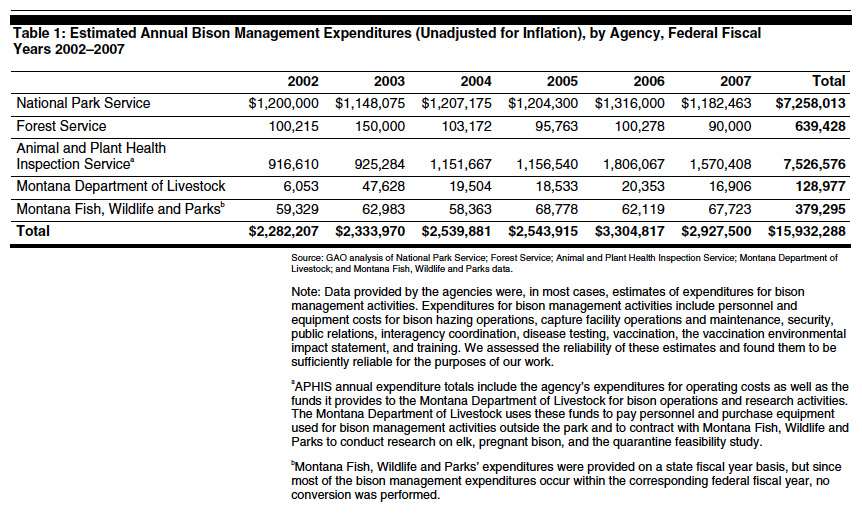
U.S. Government Accountability Office Estimated Bison Management Expenditures (Not Adjusted for Inflation) Fiscal Years 2002-2007*
 National Park Service: $7,258,013.
Forest Service: $639,428.
*Animal and Plant Health Inspection Service: $7,526,576.
Montana Department of Livestock: $128,977.
Montana Fish, Wildlife and Parks: $379,295.
Total: $15,932,288.
We don’t have more recent information yet, but at an average cost of $2,655,381 per year: if the costs have not changed, American taxpayers have spent an additional $23,898,431 dollars through fiscal year 2016.
That means that since 2002, Americans have paid nearly $40,000,000 to reduce and destroy a living national treasure.
*Figures for APHIS "include the agency's expenditures for operating costs as well as the funds it provides to the Montana Department of Livestock for bison operations and research activities. The Montana Department of Livestock uses these funds to pay personnel and purchase equipment used for bison management activities outside the park and to contract with Montana, Fish, Wildlife and Parks to conduct research on elk, pregnant bison, and the quarantine feasibility study." ~ Source: U.S. Government Accountability Office, YELLOWSTONE BISON Interagency Plan and Agencies' Management Need Improvement to Better Address Bison-Cattle Brucellosis Controversy (2008).
U.S. Department of Agriculture, Animal and Plant Health Inspection Service (APHIS) - Brucellosis budget
APHIS is involved in a multitude of brucellosis projects, including quarantine feasibility, testing of captured or slaughtered buffalo, fetal disappearance, brucellosis persistence, and the chemical drugging of Yellowstone bull buffalo to test semen. While APHIS has no jurisdiction over wildlife, the agricultural agency uses their funding influence to funnel tax dollars that affect how states manage wildlife.
FY 2002 - $10,000,000 FY 2003 - $9,000,000
FY 2004 - $10,242,000
FY 2005 - $10,356,000
FY 2006 - $10,348,000
FY 2007 - $10,506,000
FY 2008 - $9,465,000
FY 2009 - $9,584,000
FY 2010 - $9,707,000
Total expenditures equal: $89,208,000.
What will we do about it?
Remember: It is your elected officials who determine where your tax money goes.
For our part, BFC will continue educating those in public office about the expensive atrocities perpetrated under the IBMP—and keep pushing them to do the right thing for buffalo and buffalo habitat. We will also continue searching for updated financial information related to buffalo and share it with you as we get it.
The best way you can help in this particular instance is to please contact your members of Congress and ask them to redirect wasteful and costly taxpayer funding away from the IBMP. Urge them to instead use these funds to study and confirm the ESA petition we filed. [To learn more, visit our ESA advocacy page]
Will you help conserve, defend, and restore habitat? Will you be a part of this historic effort to allow America's wild buffalo to roam freely into the future?
Historians from the late 1800s offer us slightly varying numbers and accounts, but we can be confident in these tragic reports:
It is from those surviving few animals that today's Yellowstone herds, of only a few thousand animals altogether, are descended!
Tragically, more wild buffalo have been slaughtered in America since 1995 than in the entire preceding century. Think about that for a moment.
Yes, there used to be tens of millions of them. Now we have only a few thousand...but we harass, relocate, and kill these walking national treasures for the profit of a few cattle ranchers—and at the expense of we taxpayers.
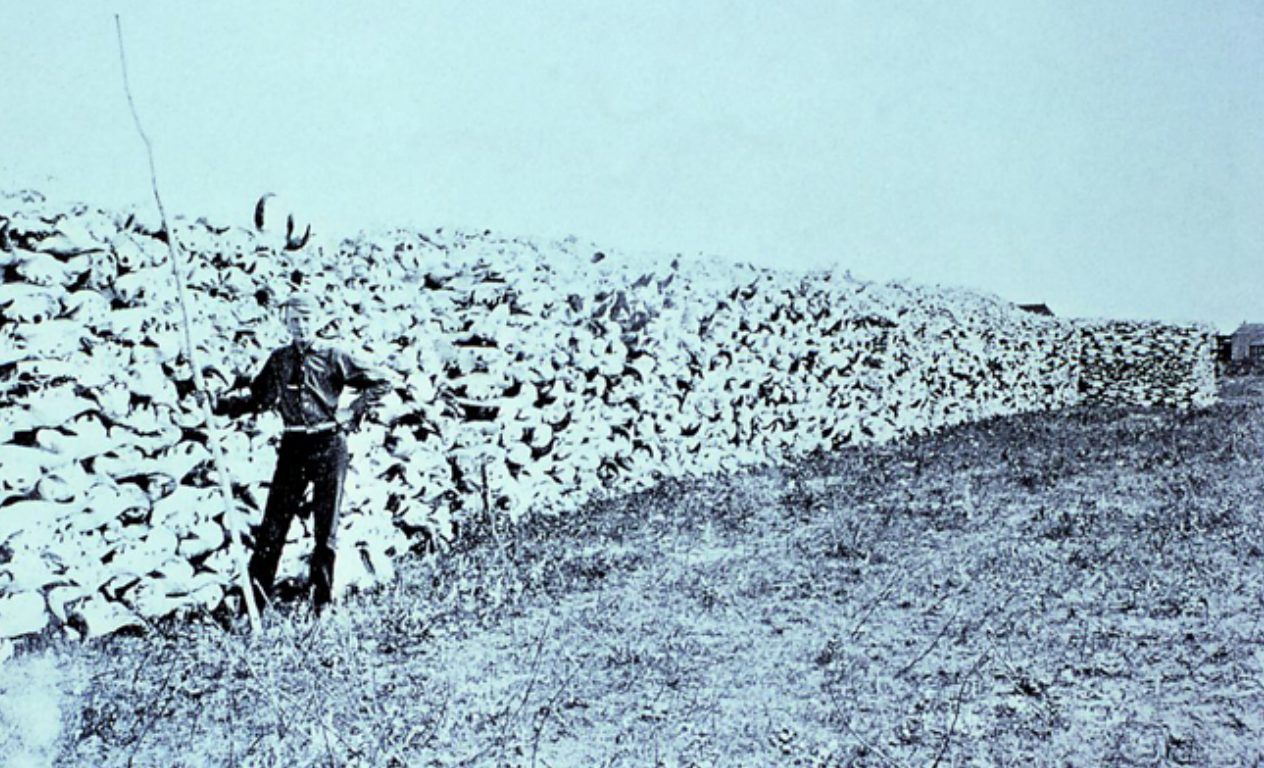
You’ve probably seen pictures like the one below, showing skulls and pelts stacked in unimaginable numbers. The result of that careless behavior is that none of us has ever heard the rumble of millions of hoofs beating through a valley in the summer sunshine...and no one will, as long as we allow business as usual."
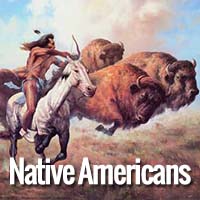
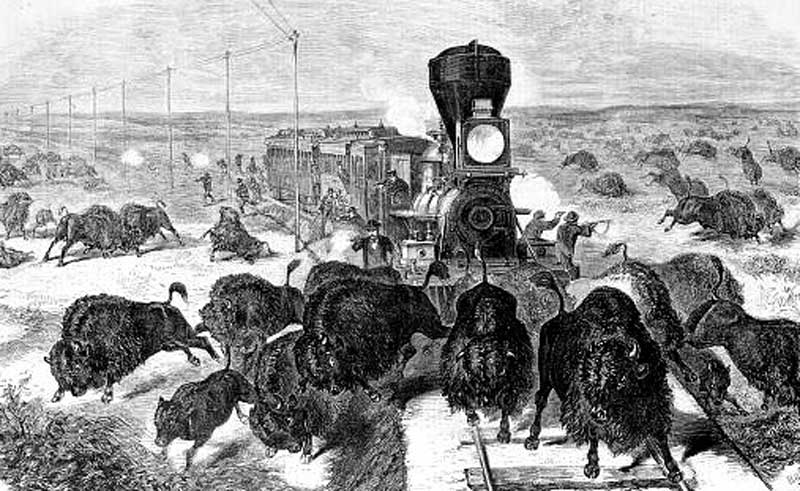
Wishing to control the land of the native people, and knowing the Indians’ complete dependence upon the buffalo, 19th century government leaders launched a campaign to wipe them out. In so doing, they forced the Indians into a sedentary lifestyle more in line with the prevailing European notions of private property and "civilization."
Secretary of Interior Columbus Delano made the following remarks in 1873, a year after Yellowstone National Park was established:
"The civilization of the Indian is impossible while the buffalo remains upon the plains. I would not seriously regret the total disappearance of the buffalo from our western prairies, in its effect upon the Indians, regarding it as a means of hastening their sense of dependence upon the products of the soil and their own labors"
~ Secretary of Interior Columbus Delano,
Annual Report of the Department of the Interior
Not only did the European settlers of the new world view the survival of buffalo as a means of perpetuating the ways of Native American life, they saw the buffalo as being incompatible with their dream of a Great Plains cattle culture.
It was a simple matter of competition; as long as buffalo remained wild, they would out-compete the cattle for grazing lands and stand as a living reminder to the uncivilized nature of a pre-settlement West.
These undercurrents come to the surface in the following speech against a bill which would have made it illegal for whites to kill buffalo. The argument, made by U.S. Representative Conger, was delivered in 1874:
"There is no law that Congress can pass that will prevent the buffalo from disappearing before the march of civilization. There is no law which human hands can write, there is no law which a Congress of men can enact, that will stay the disappearance of these wild animals before civilization. They eat the grass. They trample upon the plains upon which our settlers desire to herd their cattle and their sheep. They range over the very pastures where the settlers keep their herds of cattle. They destroy the pasture. They are as uncivilized as the Indian."
~ 1874, U.S. Representative Conger
These attitudes remain strong even today. The influence of the cattle barons is heard loud and clear while most Native American voices fall on deaf ears. To the western livestock industry, cattle represent an economic interest and way of life, although barely a hundred years old.
To Native Americans the buffalo represent the essence of their social, cultural, and spiritual identity; and a relationship that is tens of thousands of years old. Consider this: the fact that the tribes haven't been allowed serious participation in discussions where ranchers, land managers, and politicians decide the fate of the buffalo reflects both a lack of wisdom and the utter disrespect for a heritage and way of life that has existed for many tens of thousands of years—not 100.
No one has a closer relationship to the buffalo than the Native Americans. Yet why have they been and why are the tribes currently being left out? American activist, environmentalist, economist, and writer, Winona LaDuke, in an article printed in 1999 in Indian Country Today ("Winter Comes to Yellowstone: Ushering in Another Bison Kill."), raises the same question:
"Absent are the people who actually know the buffalo: the Nez Perce, Blackfeet and Crow, and others whose treaties encompass part of Yellowstone National Park, or the Winnebago, Ho Chunk, Lakota, Anishinabe, Kiowa, Gros Ventre, Cheyenne, Shoshone Bannock and others, whose spiritual practices, cultural practices, languages, and lives are entirely intertwined with buffalo. To us, the buffalo is the Western Doorkeeper, the Elder Brother, the Great One."
~ Winona LaDuke, Native rights activist
Not only is the tribal voice being ignored, but as the actions of policy makers and Montana Law Enforcement Officers attest: the religion and culture of those who consider the buffalo sacred are being willfully violated. The actions of Montana's Department of Livestock are in the same vein as the actions of their predecessors—the buffalo hunters and Army officers who perpetrated the slaughter in the 1870s.
According to Lakota leader Joseph Chasing Horse, "When the U.S. government slaughtered the buffalo as a way to subjugate Indian people, they put into motion an imbalance in the ecosystem that continues today." How true he spoke.
On March 7, 1997, during a winter when 1,084 buffalo were killed, American Indian tribal leaders from around the country gathered near Gardiner, Montana, to hold a day of prayer for the buffalo. The ceremony was disrupted by the echo of gunshots. Lakota elder Rosalie Little Thunder left the prayer circle to investigate the shots. Less than two miles away, Department of Livestock agents had killed fourteen buffalo. Walking across a field to pray over the bodies, she was arrested and charged with criminal trespass. To Little Thunder and other tribal members present there was no question of coincidence: "They shot the buffalo because we were at that place on that day at that time," she said.
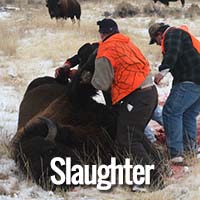
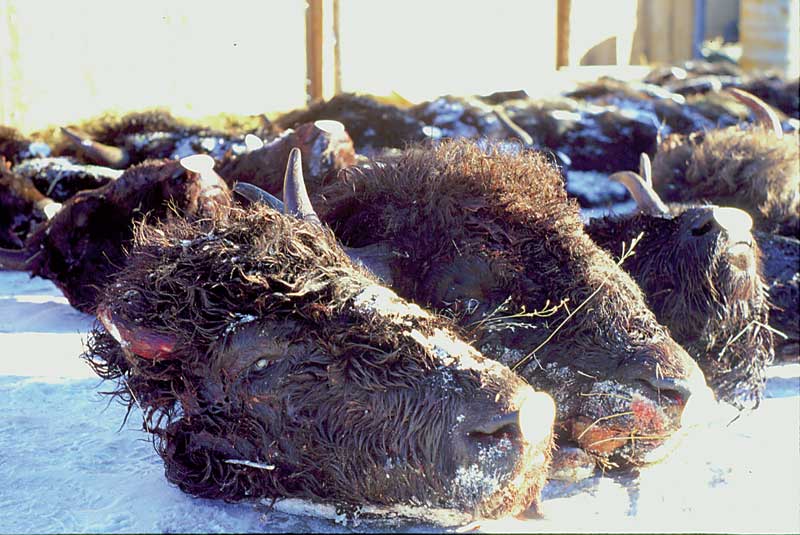 This slaughter goes on every year, though it has various names: hazing, relocation, wildlife management, etc, it is really just the continuation of a senseless path forward, driven by greed, profit, and the demand for cheap hamburgers.
Please view our chart "Yellowstone Buffalo Slaughter Totals" which documents buffalo kill numbers from 1985 to today (chart is updated regularly).
Click here for a PDF detailing Yellowstone Bison Killing History from 1901-2000
It is because of your help, and the support of people just like you, that BFC is able to reduce these numbers even as we work to obtain permanent protection for this hulking, hairy, national treasure. Will you help stop this slaughter? Will you make a donation defend the buffalo today?
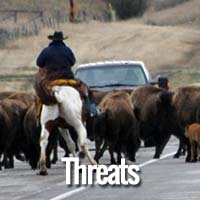
Are you wondering, "What problems are impacting the Yellowstone buffalo today?"
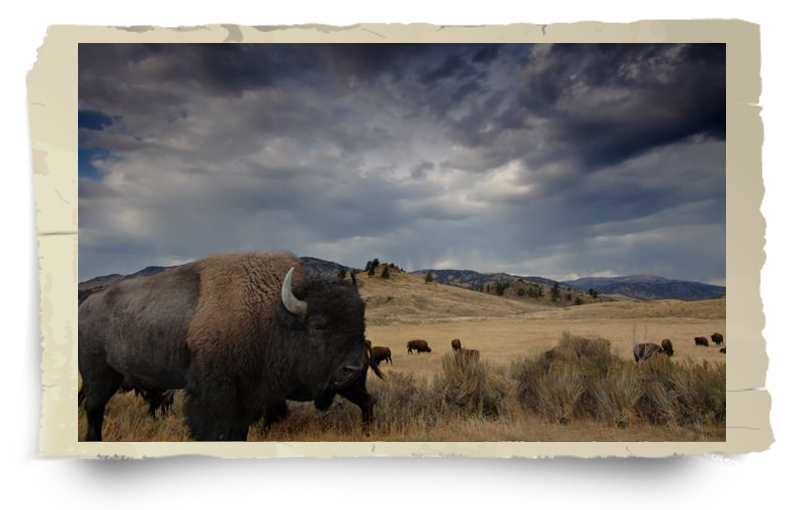 We are glad you asked! Before digging into the specifics, we’ll offer you a brief answer to your question.
Here at BFC, we spend a great deal of time and energy defending buffalo and seeking to eliminate the root causes of their problems. After standing with them for more than 20 years, we have a very good understanding of where their problems originate.
In short, the answer is this:
However, you also hold the the power to save these magnificent animals. Will you join forces with us?
We thank you for seeking to understand the complex issues affecting buffalo in today’s world, and we hope that the information on the following pages will inspire you to join us in protecting this magnificent and biologically important species!
Are you ready to help defend the buffalo?
Please join us in eradicating these man-made problems by donating to protect the last wild herds!
 Bison or buffalo?